
Web-Based Student Achievement Management System Using Student Performance Indicators
##plugins.themes.academic_pro.article.sidebar##
##plugins.themes.academic_pro.article.main##
Abstract
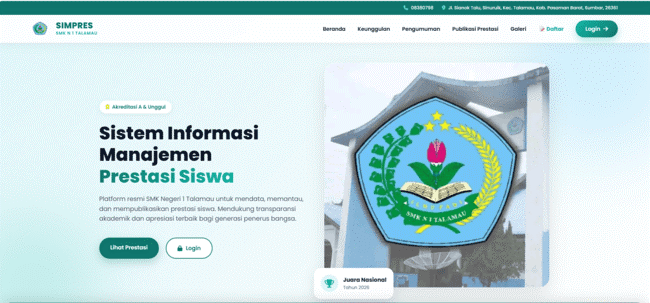
The management of student achievement and talent data in schools is still commonly conducted manually, resulting in data inconsistencies, duplication, and difficulties in accessing information. In addition, student performance evaluation is often carried out subjectively due to the absence of structured assessment indicators. This golf of this project is to create a web-based student achievement and talent management system to support student performance evaluation. The Laravel framework and MySQL database werw used in the waterfall approach of system development. The research involved system testing through Black Box Testing, GTmetrix, performance testing, and User Acceptance Testing (UAT) conducted with users of the system. To improve the objectivity of student evaluation, the system applies Student Performance Indicators (SPI) covering academic, achievement, and student activity aspects. The outcomes demonstrate the system’s ability to managing student data in an integrated manner, facilitating information access, and supporting more objective performance evaluation. The developed system can assist schools in improving the effectiveness of student achievement management and evaluation processes.
##plugins.themes.academic_pro.article.details##
References
- S. R. Putri, L. Mursyida, and M. A. Zaus, “Contribution of Student Motivation and Learning Environment to Learning Outcomes in Network System Administration Subjects Majoring in Network Computer Engineering,” vol. 01, no. 02, pp. 30–36, 2024.
- A. Mubai et al., “Implementasi Model Cipp Dalam Evaluasi Kurikulum Pendidikan Teknik Informatika,” Edukatif J. Ilmu Pendidik., vol. 6, no. 8, 2021.
- A. Razaq, “Designing an Early Warning Feature in the Grade Management Information System to Support Academic Performance Monitoring,” vol. 5, no. December, pp. 1178–1186, 2025.
- M. Yağcı, “Educational data mining : prediction of students ’ academic performance using machine learning algorithms,” 2022, doi: 10.1186/s40561-022-00192-z.
- G. Akçap, A. Altun, and A. Petek, “Using learning analytics to develop early- warning system for at-risk students,” 2019.
- L. R. Bin, E. Á. Garbin, N. M. Érnica, G. L. Griza, R. A. Conci, and L. Nadal, “The Role of Computed Tomography in Zygomatic Bone Fracture - A Case Report,” pp. 10–13, 2020, doi: 10.4103/ams.ams.
- I. P. Dewi et al., “Improving the Competence of MGMP Informatics Teachers in Preparing Gamification-Based IBT in the Era of Education 5.0,” GUYUB J. Community Engagem., vol. 6, no. 1, pp. 130–151, Mar. 2025, doi: 10.33650/guyub.v6i1.9906.
- S. Sophonhiranrak, “Heliyon Features , barriers , and in fl uencing factors of mobile learning in higher education : A systematic review,” Heliyon, vol. 7, no. October 2020, p. e06696, 2021, doi: 10.1016/j.heliyon.2021.e06696.
- R. S. Pressman, “Software Engineering : A Practitioner ’ s Approach,” no. January 2020, p. 161, 2012.
- E. Tasrif, A. Huda, H. K. Saputra, and A. Mubai, “Design of Server Performance Monitoring Application Integrated Administration Service System in Electronic Engineering Department,” J. Phys. Conf. Ser., vol. 1387, no. 1, 2019, doi: 10.1088/1742-6596/1387/1/012029.
- K. Mohammad, H. Gregory, and G. Jennifer, Non ‑ functional requirements for machine learning : understanding current use and challenges among practitioners, vol. 28, no. 2. Springer London, 2023. doi: 10.1007/s00766-022-00395-3.
- J. S. Wheaton and D. R. Herber, “Digital requirements engineering with an INCOSE-derived SysML”.
- R. Baxter, Software engineering is software engineering. 2006. doi: 10.1049/ic:20040411.
- A. Mubai, K. Rukun, and A. Huda, “Augmented Reality ( AR ) -Based Learning Media on the Subject of Computer Network Installation,” J. Pendidik. dan Pengajaran, vol. 53, no. June, pp. 213–226, 2020, doi: 0.23887/jpp.v53i2.25943.
- The Unified Modeling Language Reference Manual. 2021.
- M. N. Gedam and B. B. Meshram, “Proposed Secure Activity Diagram for Software Development,” vol. 14, no. 6, pp. 671–680, 2023.
- S. Al-fedaghi, “UML Sequence Diagram : An Alternative Model,” vol. 12, no. 5, pp. 635–645, 2021.
- B. Battulga, L. Tsoodol, E. Dovdon, N. Bold, and O. Namsrai, “Metric-based defect prediction from class diagram,” Array, vol. 27, no. July, p. 100438, 2025, doi: 10.1016/j.array.2025.100438.
- “Analysis of Factors Affecting the Successful.pdf,” 2024.
- O. Campus, “Weighting Methods for Multi-Criteria Decision Making Technique,” 2019.
- A. J. Riskia, “The Effect of Using Prezi and Canva Learning Media on Student Learning Outcomes in Basic Electronic Engineering Subjects,” vol. 01, no. 02, pp. 24–29, 2024.
- D. Irfan, L. Mursyida, and A. Mubai, “Implementation of Mobile Learning Design in the Flipped Direct Instruction Model to Increase Student Competency Using a Constructivist Approach,” J. Educ. Technol., vol. 7, no. 4, pp. 752–762, 2023, doi: 10.23887/jet.v7i4.69768.