
Development of Canva-Based Interactive Learning Media for Basic Electronics Learning in Vocational Education
##plugins.themes.academic_pro.article.sidebar##
##plugins.themes.academic_pro.article.main##
Abstract
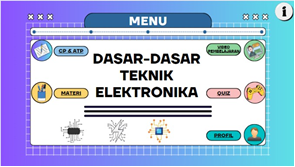
Due to the fast advancement of digital technology, new learning environments are built in vocational education by using interactive learning resources which seem essential for promoting students conceptual understanding and engagement in their learning. But in Basic Electronics courses, conventional instructional methods that are mostly dependent on lectures and printed materials lead to low participation of students paying attention during lectures and the abstract concepts are often difficult for them or for layman. The aim of this research was to produce valid and practical Canva-based interactive learning media for the Basic Electronics subject in the classroom. This research used a R&D method with the Four-D (4D) development model consisting of Define, Design, Develop and Disseminate stages. It was validated by a media expert and a subject matter expert, and then it was tested to Grade X of SMK Negeri 1 Sumatera Barat. The data was collected using expert validation questionnaires and student practicality questionnaires. Results of the validation show that the developed media earned validity score by media experts of 91% and subject-matter experts of 93% which are both categorized as very valid. In addition, the evaluation of practical learning conducted by students showed that media was highly practical and easy to use in learning activities. Thus, you have an information packet in the forms of instructional materials, videos, learning objectives, evaluations and interactive navigation delivered to the learners in one digital package that may be opened using a computer or laptop connected to the Internet. The results indicate that the interactive learning media based on Canva can be implemented as a medium of instruction to support learning in Basic Electronics in vocational education. Future research should be conducted taking into account experimental research designs to examine its effectiveness in enhancing student learning outcomes.
##plugins.themes.academic_pro.article.details##
References
- A. Huda et al., Media Animasi Digital Berbasis Hots (Higher Order Thinking Skill). Padang: UNP PRESS, 2020.
- A. G. D. Holmes, M. P. Tuin, and S. L. Turner, “Competence and competency in higher education, simple terms yet with complex meanings: Theoretical and practical issues for university teachers and assessors implementing Competency-Based Education (CBE),” Educ. Process Int. J., vol. 10, no. 3, pp. 39–52, 2021, doi: 10.22521/EDUPIJ.2021.103.3.
- K. Agustini, G. Saindra, N. Sugihartini, and G. Indrawan, “A Subak Analogy Model in Computer Network Subject for Vocational Student,” in Advances in Social Science, Education and Humanities Research (ASSEHR), 2018, pp. 177–182. doi: 10.2991/aptekindo-18.2018.39.
- A. Mubai, A. D. Samala, and N. Ulwan, “U-LAR: Ubiquitous Learning Assisted by Augmented Reality on Learning Computer Network Transmission Media,” in 2025 9th International Conference On Electrical, Electronics And Information Engineering (ICEEIE), IEEE, Sep. 2025, pp. 1–6. doi: 10.1109/ICEEIE66203.2025.11252352.
- P. Handayani and T. Y. Putro, “Assimilate of work competencies standard into learning outcomes standard to face the G-4.0 era,” IOP Conf. Ser. Mater. Sci. Eng., vol. 830, no. 4, p. 042081, Apr. 2020, doi: 10.1088/1757-899X/830/4/042081.
- P. Herlandy, F. Azim, and N. W. A. Majid, “The effectiveness of Augmented Reality based Learning on Vocational Competencies of Vocational School Students,” Edumatic J. Pendidik. Inform., vol. 4, no. 2, pp. 120–128, 2020, doi: 10.29408/edumatic.v4i2.2653.
- A. Mubai, Giatman, N. Jalinus, Syahril, and R. Abdullah, “The Effectiveness of Learning Media Based on Augmented Reality in Vocational Education : A Meta Analysis,” Ann. Rom. Soc. Cell Biol., vol. 25, no. 4, pp. 15749–15756, 2021.
- L. F. Al-Qora’n, A. Jawarneh, and J. T. Nganji, “Toward Creating Software Architects Using Mobile Project-Based Learning Model (Mobile-PBL) for Teaching Software Architecture,” Multimodal Technol. Interact., vol. 7, no. 3, p. 31, Mar. 2023, doi: 10.3390/mti7030031.
- I. P. Dewi et al., “Improving the Competence of MGMP Informatics Teachers in Preparing Gamification-Based IBT in the Era of Education 5.0,” GUYUB J. Community Engagem., vol. 6, no. 1, pp. 130–151, Mar. 2025, doi: 10.33650/guyub.v6i1.9906.
- L. Badriyah, M. Tindangen, and S. S. Adji, “International Journal of Business and Social Science Effect of Canva Application on Learning Interest and Critical Thinking of Elementary School Students,” vol. 5, no. 1, pp. 37–49, 2025, doi: 10.54099/aijbs.v5i1.1306.
- M. D. Prayogi and T. Prihatin, “Improving Students’ self-directed learning through visual novel games: its effectiveness and potential,” Indones. J. Curric. Educ. Technol. Stud., vol. 12, no. 1, pp. 45–56, Apr. 2024, doi: 10.15294/ijcets.v12i1.15307.
- J. Radianti, T. A. Majchrzak, J. Fromm, and I. Wohlgenannt, “A systematic review of immersive virtual reality applications for higher education: Design elements, lessons learned, and research agenda,” Comput. Educ., vol. 147, no. December 2019, p. 103778, Apr. 2020, doi: 10.1016/j.compedu.2019.103778.
- A. Huda et al., “Augmented Reality Technology as a Complement on Graphic Design to Face Revolution Industry 4.0 Learning and Competence: The Development and Validity,” Int. J. Interact. Mob. Technol., vol. 15, no. 5, pp. 116–126, 2021, doi: 10.3991/ijim.v15i05.20905.
- M. L. Hamzah, A. Ansharullah, Z. Rahmat, M. F. Zatrahadi, and A. A. Purwati, “Acceptance of virtual reality-based hadith learning model with technology acceptance model (TAM) approach,” JPPI (Jurnal Penelit. Pendidik. Indones., vol. 10, no. 3, p. 205, Aug. 2024, doi: 10.29210/020244277.
- P. Prismar, R. Riyanto, E. Risdianto, M. F. R. Chandra, J. S. Macariola, and S. Farooque, “Development of Android-Based Augmented Reality Learning Media to Improve Learning Independence (Study on the Electric Motor Installation Subject for Class XI Students of Rejang Lebong Regency Vocational School),” IJOEM Indones. J. E-learning Multimed., vol. 3, no. 2, pp. 60–72, 2024, doi: 10.58723/ijoem.v3i2.231.
- B. Çeken and N. Taşkın, “Multimedia learning principles in different learning environments : a systematic review,” Smart Learn. Environ., vol. 9, no. 19, pp. 1–22, 2022, doi: 10.1186/s40561-022-00200-2.
- D. Irfan, L. Mursyida, and A. Mubai, “Implementation of Mobile Learning Design in the Flipped Direct Instruction Model to Increase Student Competency Using a Constructivist Approach,” J. Educ. Technol., vol. 7, no. 4, pp. 752–762, 2023, doi: 10.23887/jet.v7i4.69768.
- A. Kristanto, “Integration of a Constructivism Approach in E-learning Photography Subjects: Feasibility and Effectiveness in Learning,” J. Educ. Technol., vol. 5, no. 2, pp. 167–174, Jun. 2021, doi: 10.23887/jet.v5i2.33380.
- L. Asnur, N. Jalinus, A. Faridah, D. Irfan, A. Mubai, and F. Utami, “Empowering Project-Based Learning Model With Video Blog,” TEM J., vol. 14, no. 1, pp. 707–715, Feb. 2025, doi: 10.18421/TEM141-63.
- R. E. Mayer, “The Past, Present, and Future of the Cognitive Theory of Multimedia Learning,” Educ. Psychol. Rev., vol. 36, no. 1, p. 8, Mar. 2024, doi: 10.1007/s10648-023-09842-1.